Home › Industrial and Heavy-Duty Asphalt Paving
We offer industrial and heavy-duty asphalt paving in Greensboro, NC for facilities that handle trucks and equipment. Our designs use thicker sections and strong bases to withstand heavy loads. Protect your operations with reliable pavements that resist rutting and failure.
Precision Asphalt Greensboro provides professional industrial asphalt paving throughout Greensboro, NC, North Carolina and the surrounding area. Our licensed, insured crew delivers safe, clean, on-time work with a free estimate before anything begins. Call (336) 604-0154 or request your free quote.
Industrial Asphalt Paving Built for Greensboro’s Toughest Sites
Industrial and heavy-duty asphalt paving is very different from paving a driveway or small parking lot. At Precision Asphalt Greensboro, we design pavements that handle constant truck traffic, forklifts, loaded trailers, and long-term fuel and chemical exposure common around Greensboro’s manufacturing plants and distribution hubs.
We begin every industrial asphalt paving project with a site-specific traffic and loading analysis. For a warehouse near Bryan Park or a plant off I-85, we look at the number of trucks per day, wheel loads, turning patterns at dock doors, and where trucks idle. This drives our pavement thickness, base design, and asphalt mix selection. For heavy-use loading docks and dumpster pads, we often recommend reinforced concrete tie-ins or thicker asphalt sections to prevent rutting and shoving.
Greensboro’s mix of older industrial buildings and newer distribution centers means subgrade conditions vary a lot. Former mill sites and brownfields often have fill, buried debris, or poorly compacted soils that must be corrected before paving. On newer industrial parks along the 840 loop, the soils are more uniform, but heavy clay still requires careful moisture control and drainage planning. Our designs are tailored to each site, not copied from a standard parking lot template.
Site Evaluation, Design, and Engineering for Heavy-Duty Loads
A durable industrial asphalt system starts with a disciplined evaluation and design process. Precision Asphalt Greensboro takes core samples where needed, performs proof-rolling with heavy equipment to identify soft spots, and checks drainage paths so stormwater does not sit on or under the pavement. We pay close attention to transitions between existing pavement and new work, which are common failure points on industrial lots.
Using data from the site visit, we determine the overall pavement structure. This usually includes a compacted subgrade, an aggregate base layer (often 6 to 12 inches for truck areas), and two or more asphalt lifts. In very high load zones, such as intermodal yards or scrap recycling facilities, we may specify thicker base and asphalt layers to handle repetitive loading.
We also look at operational details. On a manufacturing campus in Greensboro, that might mean planning heavier sections at truck scale approaches, forklift crosswalks, and fuel station lanes, with standard heavy-duty sections elsewhere. We coordinate with plant managers to protect critical utilities like gas lines or process trenches that run beneath the pavement, adjusting design so future maintenance can be done without destroying the pavement structure.
How We Build Industrial and Heavy-Duty Asphalt Pavement
Once design is set, the field work begins. The first step is demolition and removal of existing pavement or unsuitable soils. Our crew mills or saw-cuts existing asphalt and concrete to create clean, stable edges that can be tied into. On older Greensboro industrial sites, we often uncover unexpected buried concrete or old rail lines, which we remove or bridge properly so they do not cause future cracking.
Next comes subgrade preparation. We regrade to the specified elevations, compact the soil with heavy rollers, and correct any weak areas with undercutting and replacement stone or soil stabilization. Proper compaction is verified layer by layer. This step is critical in Piedmont clay soils, which hold moisture and can pump under repeated loads if not addressed.
We then install and compact the aggregate base, typically using crushed stone that locks together under rolling. For high-traffic truck lanes and container yards, we may use a thicker base to improve load spreading. Joints are staggered to avoid continuous weak planes through the section.
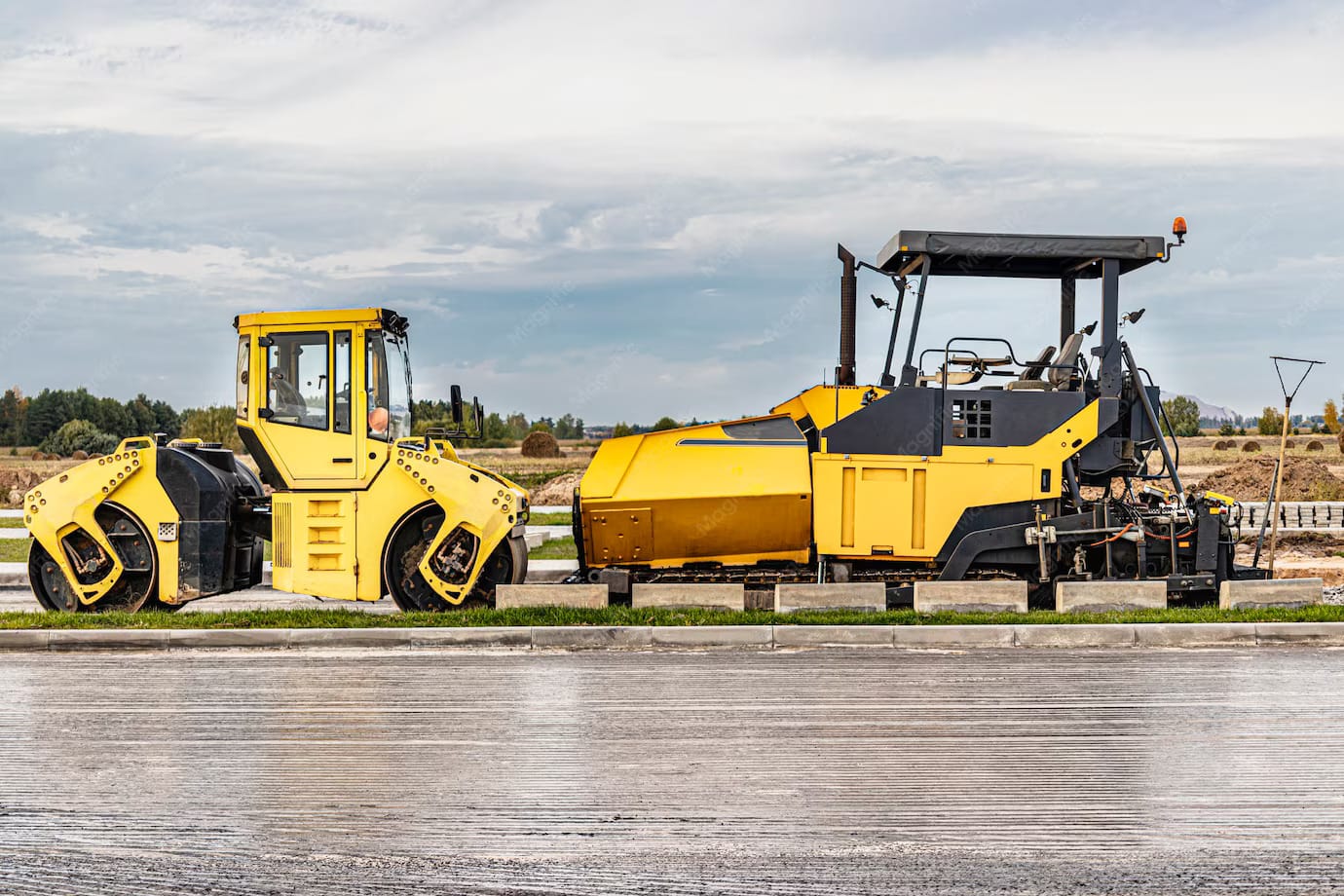
Finally, we place multiple asphalt lifts. A common industrial section might be a 3 to 4 inch base course, followed by a 2 to 3 inch surface course in heavy traffic areas. For the most demanding applications, we may add an intermediate binder course between them. Each lift is placed with a paver, compacted with steel drum and pneumatic rollers, and checked for density and smoothness so the structure acts as a unified load-bearing system.
Material Options, Mix Designs, and Local Performance Factors
Industrial asphalt paving is not one-size-fits-all. Precision Asphalt Greensboro selects mix designs based on anticipated loading, temperature swings, and site usage. For heavy truck areas, we often specify a performance-graded asphalt binder with higher resistance to rutting in Greensboro’s hot summers. Aggregate gradation and angularity are chosen to resist shoving where trucks brake and turn sharply, such as at dock doors or guard stations.
In some plants where chemical spills or fuel exposure are likely, we may recommend specific surface courses with better resistance to softening. For container and flatbed yards that experience point loads and slow traffic, we often lean toward mixes with higher stability instead of maximum smoothness. Different sections of the same property might use different mixes, all designed to work together structurally.
We also account for Greensboro’s freeze-thaw cycles and occasional snow events. Although our winters are moderate, trapped water under or within the pavement can still disrupt the structure. This is why we specify appropriate air voids, drainage features, and edge details. Proper compaction and correct mix design reduce susceptibility to stripping and moisture damage, a common issue when heavy trucks repeatedly force water into the pavement layers.
Cost Drivers and How to Control Your Industrial Paving Budget
Industrial asphalt paving costs are driven by more than just square footage. Key factors include pavement thickness, base depth, existing pavement demolition, and how much subgrade correction is needed. Heavier truck loads or container stacking require thicker sections, which increases both material and labor costs, but reduces the risk of premature failure.
On many Greensboro projects, unknown existing conditions are the biggest risk to budget. Old fill, buried rubble, or saturated clay pockets can require undercut and replacement. Precision Asphalt Greensboro mitigates this through upfront evaluation, clear allowances for remediation, and phased construction that lets owners make informed decisions as conditions are uncovered.
You can control costs by prioritizing the most critical areas for the heaviest design. For example, we might design premium sections for loading docks, traffic loops, and fueling stations, while using a slightly lighter heavy-duty section in overflow truck parking. Coordinating paving work with other site improvements, such as drainage upgrades or utility work, also helps avoid cutting into new asphalt later, which is more expensive than planning utility runs before paving.
Common Industrial Pavement Problems and How We Prevent Them
Industrial pavements typically fail from repeated heavy loads, poor drainage, or inadequate base preparation. Early signs include rutting in wheel paths, alligator cracking in truck lanes, and shoving or pushing in braking and turning areas. On local Greensboro lots, we often see failure around older dock approaches where trucks concentrate loads in the same tracks every day.
Precision Asphalt Greensboro designs specifically to limit these issues. Strategically thicker asphalt and base layers are placed in the wheel paths of primary truck lanes. We manage grades and install adequate inlets or swales so water does not pond near docks or edges, and we avoid thin feathered edges that crumble under truck tires. Where trucks transition from asphalt to concrete at docks or inside the plant, we build reinforced transitions that distribute loads instead of allowing sharp breaks.
When rehabilitating existing industrial pavements, we do not simply overlay and walk away. We mill out rutted areas, repair base failures, and address drainage problems before new asphalt is placed. In some cases, especially around compactors or heavily loaded dumpsters, we recommend swapping to reinforced concrete pads tied into the surrounding heavy-duty asphalt to prevent repeated edge failures.
Planning, Phasing, and Working Around Active Industrial Operations
Most industrial facilities in Greensboro cannot shut down for paving. Precision Asphalt Greensboro is used to working around production schedules, shift changes, and truck appointments. We coordinate phasing so critical access points remain open, often working in off-hours or weekends to minimize disruption.
We divide large sites into logical zones so trucks, employee vehicles, and emergency access can be rerouted as work progresses. Clear signage, cones, and on-site coordination with your operations team help keep traffic flowing safely. For sensitive facilities, such as food processing or pharmaceutical plants, we follow additional cleanliness and security protocols while still delivering structurally sound heavy-duty pavements.
Before any work begins, we hold a planning meeting to review staging areas, material delivery routes, and safety requirements specific to your site. We then provide a schedule that sequences demolition, base work, and paving in a way that aligns with your production priorities. The result is industrial asphalt paving that meets the structural demands of your operation without unnecessary downtime or confusion for your team and drivers.